Explore Elderly Welfare in Kerala and India, including government schemes for senior citizens. It covers old-age pensions, healthcare services, social security, and institutional care.Kerala’s Vayomithram, Mandahasam, Vayoraksha, and Sayahnam schemes support aging residents. Additionally, National programs promote healthy, safe, and dignified aging. Learn how policies and support systems create an elder-friendly Kerala and India
“Our elders are not a liability; they are the reason we exist as we do today. Through decades of sacrifice, devotion, and sheer hard work, they shaped the world we live in. They built the foundation so that we could stand tall. We must never overlook or underestimate what they have given us. Standing where we are now is only possible because they walked the path first. They deserve our deepest respect and undivided dignity, for they are our roots, our story, and the guardians of who we are”: –Skpian
“Let’s keep spreading the message: Every senior citizen deservesdignity, security, respect, and a happy life”
(State Initiatives, National Programs, Financial Security And The Way Forward-Prepared From The Available Sources – By Skpian)
THE KERALA STATE ELDERLY COMMISSION BILL, 2025 (Download Here)
Introduction
Kerala is experiencing a significant demographic transition. The share of people aged 60 and above is steadily increasing. Longer life expectancy contributes to this change. Declining birth rates and the migration of working-age people also contribute. As the population ages, the need for accessible healthcare becomes clear. Income security and appropriate care services are also vital. Protection from neglect and abuse remains important for communities. This reflects Elderly Welfare in Kerala.
Older people should not be viewed only as recipients of assistance. They bring knowledge, experience and skills to their families and communities and should have opportunities to remain independent, socially connected and involved in public life. An effective approach to aging therefore combines social protection with dignity, participation, preventive healthcare and age-friendly services.
Part I: Elderly Welfare in Kerala
1. Kerala’s Changing Demographic Profile
Kerala’s aging population has important implications for healthcare, care-giving, pensions, housing and community support. The supplied material cites projections that more than one-fifth of the State’s population may be aged 60 or above by 2031. This projection should be checked against the latest official demographic source before publication.
The State’s response needs to recognize the different circumstances of older people. Some require regular medical attention, assistance with daily activities or residential care. Others may wish to continue working, learning, volunteering or participating in community life. Policies and services should respond to this diversity.
2. Major Welfare Schemes and Services in Kerala
2.1 Vayomithram Scheme
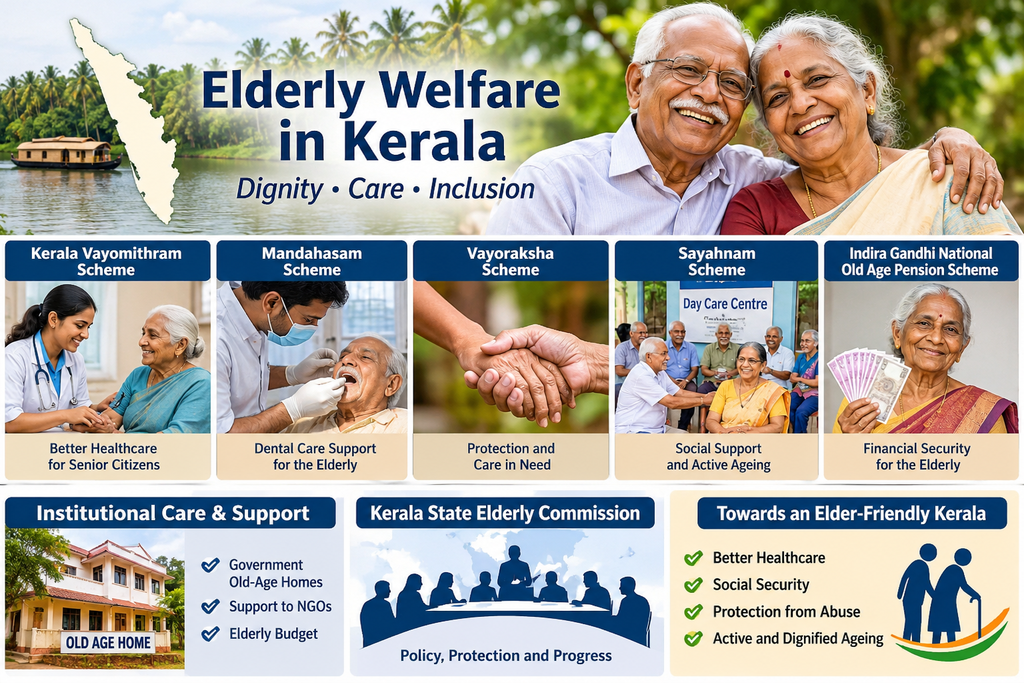
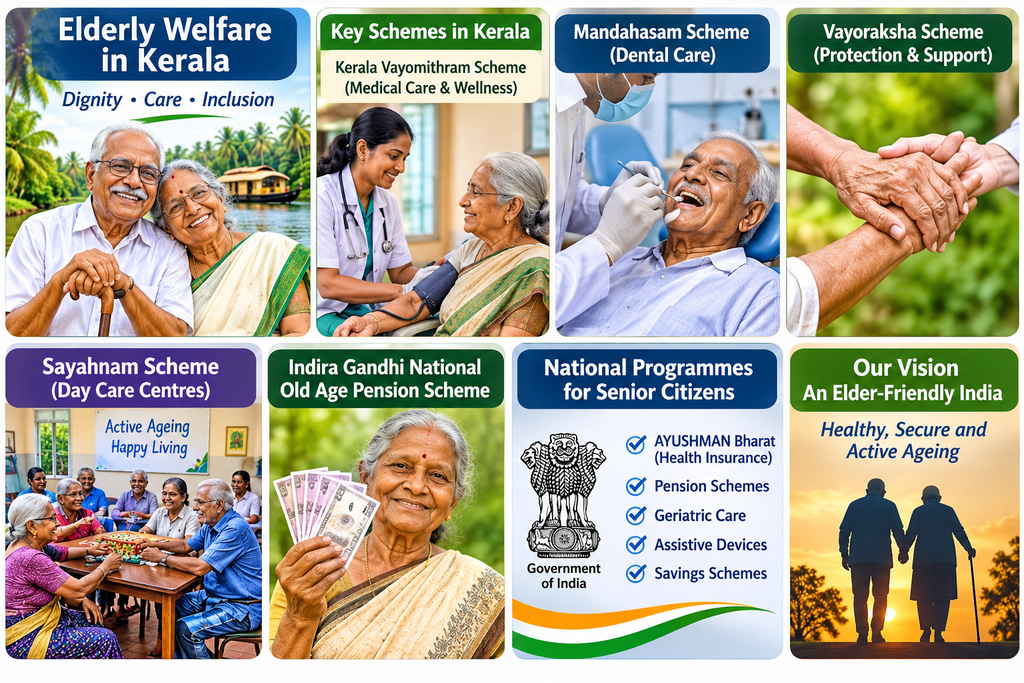
The Vayomithram Scheme aims to improve access to healthcare for senior citizens, particularly in municipal and corporation areas. The services described in the source material include medical consultations, medicines, health camps and mobile clinic services. Basic counseling and recreational opportunities can also help reduce loneliness and support emotional well-being.
2.2 Mandahasam Scheme
The Mandahasam Scheme provides assistance to eligible senior citizens from below-poverty-line households for dental care, particularly artificial dentures. By supporting oral health, eating ability and confidence, the scheme can contribute to older people’s overall quality of life. Eligibility and assistance are governed by the applicable scheme guidelines.
2.3 Vayoraksha Scheme
The Vayoraksha Scheme focuses on support for older people facing neglect, abandonment, abuse or other vulnerable circumstances. The source material describes assistance that may include help with emergency medical needs, temporary shelter and essential supplies. Timely referral and coordination with the appropriate authorities are important when an older person is at risk.
2.4 Sayahnam Scheme
The Sayahnam Scheme promotes day-care facilities for senior citizens. Such centers can provide opportunities for social interaction, meals and recreational activities, particularly for people who live alone or whose family members are away during the day. Community-based spaces can help reduce isolation and encourage active aging.
2.5 Social Security Pensions
Social security pensions provide an important source of income for eligible older people, especially those with limited financial resources. In Kerala, old-age pension support forms part of the wider social security system. Applicants should consult the relevant government department or local self-government institution for current eligibility requirements, application procedures and benefit amounts.
3. Institutional Care and Community Support
Kerala’s elderly-care framework also includes residential and community-based services intended to support people who cannot rely on adequate family care or who need additional assistance.
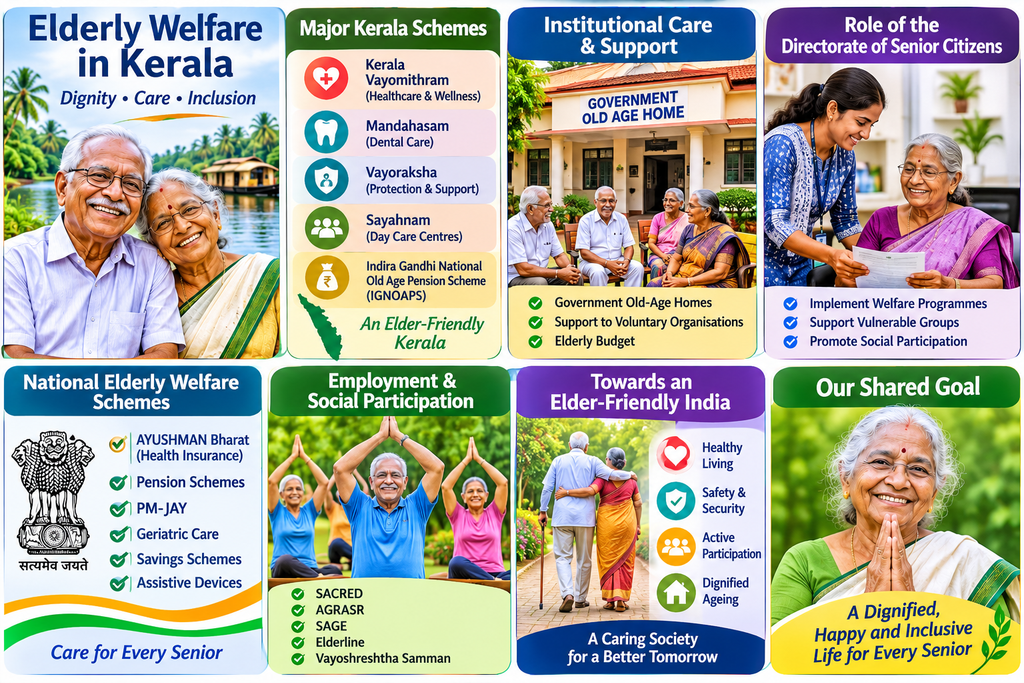
· Government old-age homes: residential support, food, basic care and other services for eligible older people who require institutional care.
· Support to voluntary organizations: eligible organizations may receive grants or other assistance to operate facilities and services for senior citizens.
· Day-care and community centers: spaces for social contact, recreation, meals and organized activities.
· Home-based care and caregiver support: areas for continued development as the need for long-term care grows.
The availability, admission criteria and services of individual facilities should be confirmed with the relevant authorities before directing readers to them.
4. Kerala’s Elderly Budget and Recent Initiatives
It is stated that Kerala’s 2026–27 State Budget introduced a dedicated Elderly Budget and reports an allocation of ₹36,812.14 crore, representing 18.74 per cent of the total State Budget. It also cites a ₹50 crore allocation for a pneumococcal vaccination drive for senior citizens.
The source material also refers to geriatric clinics, community-based healthcare, medicine and elderly-friendly hospital facilities. Together, such measures can help older people obtain appropriate care closer to home and support earlier identification of health concerns.
Community initiatives such as Pakalveedu and VayoClubs are described as ways to strengthen social connections and participation. Priorities for further development include trained caregivers, accessible public spaces, reliable home-based services and opportunities for older people to contribute their skills and experience.
5. Kerala State Elderly Commission: Role and Importance
The Kerala State Elderly Commission is discussed as a specialized institutional mechanism for addressing the rights, welfare and dignity of senior citizens. A dedicated commission, within the powers assigned to it by law, could help bring greater focus to concerns affecting older people, examine gaps in services, encourage coordination between departments and promote awareness of senior citizens’ rights. Its potential areas of concern include neglect, abuse, social isolation, healthcare access, financial insecurity and barriers to essential services. An effective institutional response should support three connected aims:
1. Prevention: increase awareness of older people’s rights, identify risks and encourage safeguards in families, institutions and communities.
2. Early response: make it easier for older people to raise concerns and ensure that complaints are assessed and referred promptly to the appropriate authority.
3. Prevention of repeated harm: support follow-up, coordination and accountability, and use lessons from cases of abuse, neglect or service failure to improve practice.
The effectiveness of any such institution depends on its statutory mandate, accessibility, staffing, funding, professional expertise, complaint-handling procedures and coordination with existing services.
6. Policy Priorities for an Elder-Friendly Kerala by 2031
As Kerala approaches the 75th anniversary of its formation in 2031, it has an opportunity to strengthen an inclusive model of aging. Priorities include:-
· Accessible, affordable and age-appropriate healthcare, including preventive and geriatric services.
· Reliable income support and better public awareness of eligible pensions and savings options.
· Protection from abuse, neglect, abandonment and financial exploitation.
· Appropriate residential care, home-based services and support for family and professional caregivers.
· Accessible public spaces, transport and services designed with older people’s needs in mind.
· Community programs that reduce loneliness and support recreation, learning, volunteering and participation.
· Meaningful involvement of senior citizens in planning and evaluating policies that affect them.
Progress will require cooperation among government departments, local self-government institutions, healthcare providers, voluntary organizations, families and senior citizens themselves.
Part II: National Programs and Support for Senior Citizens
7. Atal Vayo Abhyuday Yojana (AVYAY)
Atal Vayo Abhyuday Yojana is a central government umbrella initiative administered by the Ministry of Social Justice and Empowerment. The source material describes it as supporting senior citizens’ quality of life through care services, social security and opportunities for active aging. Its related initiatives address residential care, assistive devices, employment and innovation.
7.1 Integrated Program for Senior Citizens (IPSrC)
The Integrated Program for Senior Citizens supports eligible organizations operating facilities such as senior citizens’ homes, continuous-care homes and mobile medicare units. These services can help older people who lack adequate family support or require residential care and assistance. Support is subject to the program’s current guidelines.
7.2 Rashtriya Vayoshri Yojana (RVY)
The Rashtriya Vayoshri Yojana aims to help eligible senior citizens experiencing age-related physical difficulties by providing assistive devices. Depending on need and eligibility, devices may include walking sticks, walkers, crutches, wheelchairs, hearing aids, spectacles and artificial dentures. The scheme is intended to support mobility, communication and greater independence. Current eligibility conditions and the list of available devices should be checked against official guidance.
7.3 State Action Plan for Senior Citizens (SAPSrC)
The State Action Plan for Senior Citizens encourages States and Union Territories to plan elderly-welfare measures in response to their demographic and social circumstances. It provides a framework for identifying priorities and preparing action plans, subject to applicable guidelines. For Kerala, such planning can help align national objectives with local needs, including long-term care, migration-related family separation and community-based support.
8. Pension and Income-Security Programs
8.1 Indira Gandhi National Old Age Pension Scheme (IGNOAPS)
IGNOAPS is part of the National Social Assistance Program and provides pension assistance to eligible older people from economically vulnerable households. State-level arrangements may supplement central assistance. Eligibility, pension amounts and application procedures should be confirmed with the relevant government authority.
8.2 Atal Pension Yojana (APY)
Atal Pension Yojana is a voluntary, contributory pension scheme intended primarily to help eligible subscribers build retirement income through regular contributions. The source material describes pension options ranging from ₹1,000 to ₹5,000 per month from age 60, subject to the scheme’s conditions. Since enrollment and contributions generally take place before retirement, APY is a retirement-planning measure rather than a general pension for all current senior citizens. Readers should check current eligibility rules before applying.
8.3 Pradhan Mantri Shram Yogi Maan-Dhan Yojana (PM-SYM)
PM-SYM is a voluntary contributory pension scheme for eligible workers in the unorganized sector. The source material lists occupations such as street vending, agricultural labor, construction work, domestic work, fishing and other informal or self-employed work among the groups for whom retirement security may be relevant. The source material describes general eligibility conditions including an entry age of 18–40 years, monthly income of ₹15,000 or less, and restrictions relating to membership of specified formal social-security schemes. It also describes shared monthly contributions, matching contributions by the Central Government and an assured pension of ₹3,000 per month from age 60, subject to the scheme’s conditions. These requirements should be verified against current official guidance.
8.4 Senior Citizens’ Savings Scheme (SCSS)
The Senior Citizens’ Savings Scheme is a government-backed savings option for eligible investors, primarily people aged 60 and above. It provides interest payments at regular intervals and may help with predictable household or medical expenses. The source material cites a maximum deposit limit of ₹30 lakh and an interest rate of 8.2 per cent per annum; the applicable limits and rate can change and must be checked for the relevant investment period. Individuals should also consider their income needs, investment period and tax position.
9. Healthcare and Medical Protection
9.1 Ayushman Bharat – Pradhan Mantri Jan Arogya Yojana (AB PM-JAY)
The supplied material states that AB PM-JAY has been expanded to cover all senior citizens aged 70 and above, irrespective of socioeconomic status, subject to scheme conditions. It describes health coverage of up to ₹5 lakh per year for eligible hospitalization expenses. Readers should check current enrollment procedures, eligibility documentation, covered treatments and package conditions through official channels.
9.2 National Program for Health Care of the Elderly (NPHCE)
The National Program for Health Care of the Elderly aims to strengthen age-appropriate healthcare in the public health system. The program’s described focus includes geriatric outpatient services, care at designated health facilities, preventive healthcare, early identification of age-related conditions, rehabilitation and awareness of older people’s health needs. These services can complement Kerala’s state-level geriatric healthcare initiatives.
10. Employment, Skills and the Silver Economy
10.1 Senior Able Citizens for Re-Employment in Dignity (SACRED)
The SACRED initiative was designed to connect senior citizens who wish to continue working with suitable employment opportunities. It recognizes that older people may have valuable professional experience and practical skills. The current operational status of the portal and availability of opportunities should be verified.
10.2 Action Groups Aimed at Social Reconstruction (AGRASR)
AGRASR is described in the source material as encouraging senior citizens to form self-help groups, share experience and engage in productive community activities. Such groups may create opportunities for skill-sharing, collective enterprise and participation, subject to applicable program rules.
10.3 Seniorcare Ageing Growth Engine (SAGE)
SAGE aims to encourage innovation in products and services for older people, including assistive technology, healthcare solutions, age-friendly products and care services. The supplied material cites a potential equity-support framework for selected start-ups, but the amount and conditions should be checked from current official program documents.
11. Other Support: Helpline, Recognition and Partnerships
11.1 National Helpline for Senior Citizens – Elderline
The source material identifies Elderline as a national helpline through which older people can seek information, assistance and support with concerns such as neglect, abuse, abandonment or difficulty accessing services. It lists the toll-free number as 14567. The number, hours of operation and services available in Kerala should be verified so that readers receive accurate contact information.
11.2 Vayoshreshtha Samman
Vayoshreshtha Samman recognizes the contributions of senior citizens and the work of organizations involved in elderly welfare. The awards highlight active aging and challenge stereotypes by acknowledging the continuing contribution of older people to families, communities and public life. Categories and award details should be checked against the current official notification.
11.3 Corporate Social Responsibility (CSR) for Elderly Care
The supplied material notes that eligible CSR activities under Schedule VII of Section 135 of the Companies Act, 2013 can include support for old-age homes, day-care centers and facilities for senior citizens. CSR partnerships may complement public funding by helping eligible organizations improve infrastructure and community-based services. Such support should be implemented transparently and in response to the needs of older people.
12. How National Programs Can Support Kerala
National programs can complement Kerala’s state-level welfare measures when information and services are accessible at the local level. Assistive devices can support mobility and independence; pensions and savings schemes can contribute to income security; healthcare programs can help reduce the burden of eligible medical expenses; and employment or self-help initiatives can provide opportunities for continued participation.
Kerala can improve the impact of these programs by raising public awareness, helping eligible people navigate applications, strengthening coordination among local institutions and service providers, and identifying people who may be excluded by financial, geographical or administrative barriers. The Kerala State Elderly Commission, within its verified statutory role, may also contribute to a more coordinated response.
Conclusion: Towards Dignity, Security and Meaningful Ageing
Supporting senior citizens requires more than financial assistance alone. It calls for a coordinated approach that brings together income security, accessible healthcare, appropriate care facilities, assistive support, protection from abuse and opportunities for social participation.Kerala’s state-level initiatives and the national programs described in this article provide a foundation on which to build. Their impact depends on accurate public information, effective implementation, sustained resources and cooperation among government agencies, local institutions, voluntary organizations, families and older people themselves.
The ultimate goal should be a society in which older people can live safely, maintain their independence wherever possible, remain connected to their communities and be respected for their choices, experience and contributions.
Disclaimer: This article is a general guide compiled from available sources and has not been independently fact-checked. Figures, eligibility rules, benefits, helpline details, and the legal status of the Kerala State Elderly Commission should be verified with official sources before taking action. The author (“Skpian“) assumes no legal responsibility for the accuracy of this content.